Grüsch dich Meiner!


Welcome to my webpage. This page will help you get to know me better:

  • What work pays my bills? (see About)
  • How to reach me (see Contact)
  • My heartfelt project and my book reviews (see Money Talks)
  • My other projects (see GitHub Projects)

Feel free to scroll through my site. If you encounter anything of interest or any oopsie-daisies, feel free to contact me.

Review: Hedge Funds and the Collapse of Long-Term Capital Management

by Franklin R. Edwards

Figure 1: Even brilliant economists can gamble away money.

Wachmals image LTCM

“Source: Edwards, F. R. (1999). Hedge funds and the collapse of long-term capital management. Journal of Economic Perspectives, 13(2), 189-210.”

Introduction

My preparations for the review of the book Money Magic by Laurence J. Kotlikoff led me to sink into a Wikipedia rabbit hole. Especially the time in which I tried to grasp the ideas behind the Merton–Samuelson theorem led me to consult the Wikipedia pages of Robert C. Merton and Paul Samuelson for hours and hours, impressed by their huge contributions to economics as a science. However, one instance in the life of Merton interested me in particular: his involvement in the hedge fund Long-Term Capital Management (short: LTCM), whose collapse in 1998 almost led to a global financial disaster. Curious about the matter and not fully satisfied with the corresponding Wikipedia page, I fortunately found the well-written article Hedge Funds and the Collapse of Long-Term Capital Management by Franklin R. Edwards. The article not only describes the timeline of the LTCM collapse in an interesting fashion, it also explains the functioning of hedge funds and why they can fail. So let’s dive into it.

[Read More]
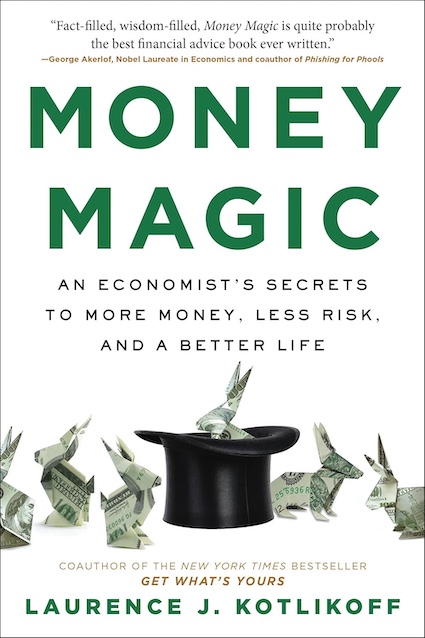
Review: Money Magic

by Laurence J. Kotlikoff

Cover Book Money Magic

“I once asked a roomful of economists — all of whom were gathered to discuss household personal finance — to answer, on the fly, the consumption-smoothing question for a hypothetical forty-year-old. I gave them the pertinent information and watched their faces. They weren’t happy. They knew they were about to produce a very wrong answer. Right then and there, they seemed to realize that even financially literate people like themselves couldn’t make proper financial decisions via introspection.” (p. 6)

[Read More]

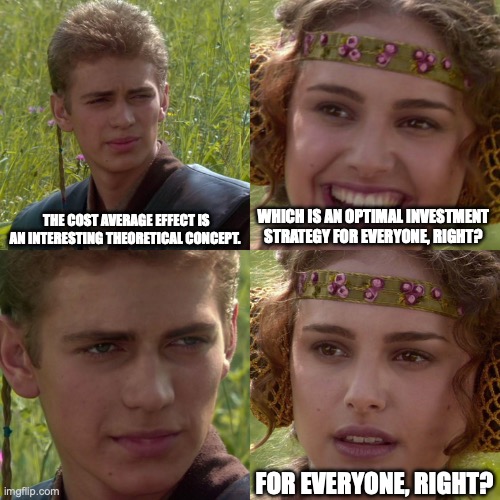
(Almost) Too Good to Be True: The Cost-Average Effect

Anakin - Padme - Cost-Average-Effect

Context: The idea for this meme came to me during the process of applying to a company active in the financial market. I remembered the time when, as a student, I was already searching for big money and believed I would find it at a financial distribution firm.

One of the sales arguments back then was the so-called Cost-Average Effect (in German: Durchschnittskosteneffekt, also referred to in English as dollar-averaging effect). This concept describes regular investments of fixed amounts into (volatile) securities, where price fluctuations lead to purchasing shares at a lower average price. When prices are high, fewer shares are bought; when prices are low, more shares are purchased, so that per share the harmonic mean rather than the arithmetic mean of prices is paid. Or put differently: price losses weigh less heavily because through regular purchases of shares, more shares are acquired during bad periods, allowing for stronger participation in future price gains. It therefore reduces the risk of loss of such investments - at least that is the theory.

[Read More]