On March 15, 2020, nearly ten million eligible voters in Bavaria went to the polls for local municipal elections — just days after the WHO had officially declared COVID-19 a pandemic. While other German states and many countries postponed elections or switched entirely to mail-in voting, most Bavarians cast their vote in person, as usual. A few weeks later, Bavaria had the highest COVID-19 case and death counts of any German state.
Was this a coincidence — or did the election itself contribute to the spread of the virus? That’s exactly the question we investigate in our new study, which has just been accepted for publication in the European Journal of Health Economics.
How we approached the question
We combined two independent empirical strategies:
1. The Synthetic Control Method: Bavaria vs. “Synthetic Bavaria”. Using the so-called Synthetic Control Method (SCM), we constructed a statistical “twin” for each of Bavaria’s 96 districts out of all non-Bavarian districts — a synthetic control district. In simplified terms, it works like this: a weighting procedure assigns each non-Bavarian district a weight based on how closely it resembled the given Bavarian district before the election — in terms of population structure, economic conditions, health care provision, childcare availability, and prior COVID-19 case numbers. These weights are then multiplied by the actual COVID-19 figures of the respective districts after the election and summed up. The result is the fictional, “synthetic” value that the Bavarian district would presumably have reached had it not been affected by the election.1 Aggregating these synthetic values across all Bavarian districts yields an estimate of how case numbers in Bavaria would likely have developed without the election.
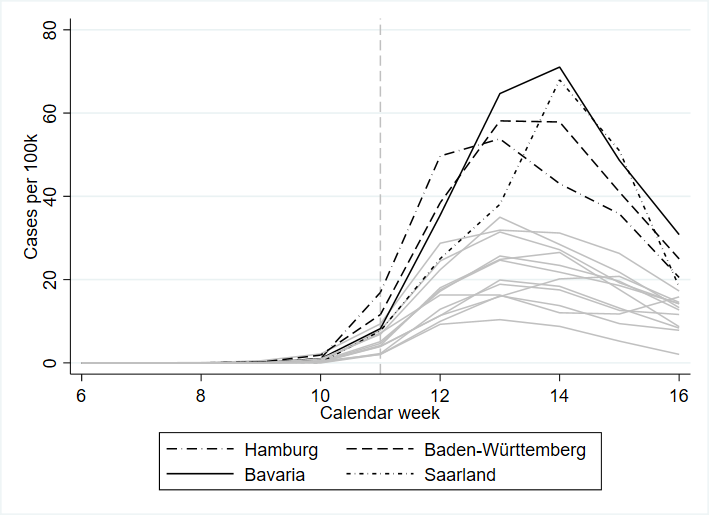 Figure 1: Weekly COVID-19 cases across German states — Bavaria clearly diverges from the rest starting the week after the election.
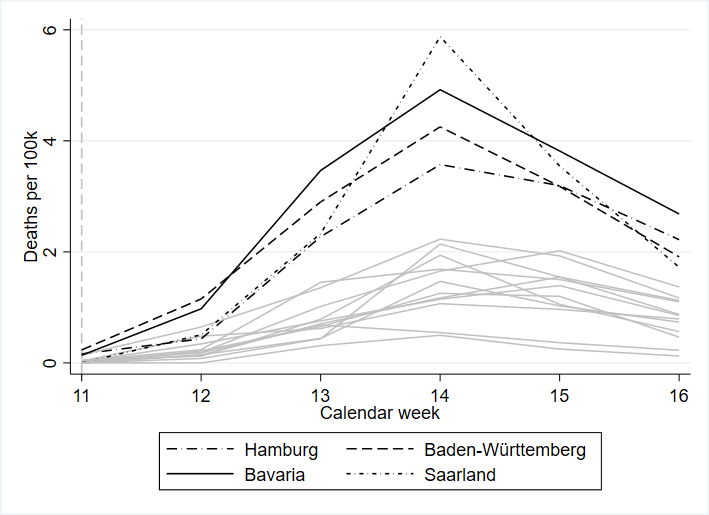 Figure 2: Weekly COVID-19 deaths across German states — Bavaria diverges here too, following the election.
2. A within-Bavaria comparison. We also examined whether Bavarian districts with higher voter turnout experienced a steeper rise in case numbers after March 15 than districts with lower turnout — while controlling for alternative explanations, such as distance to the COVID-19 hotspot Ischgl or the number of “Starkbier” (strong beer) festivals held shortly before the lockdown.
What we found
- Bavaria saw a substantially steeper rise in COVID-19 cases after the election than the trajectory of comparable districts would have predicted — over a third of the post-election increase in case numbers cannot be explained by demographic, economic, or health-related differences, nor by proximity to Ischgl.
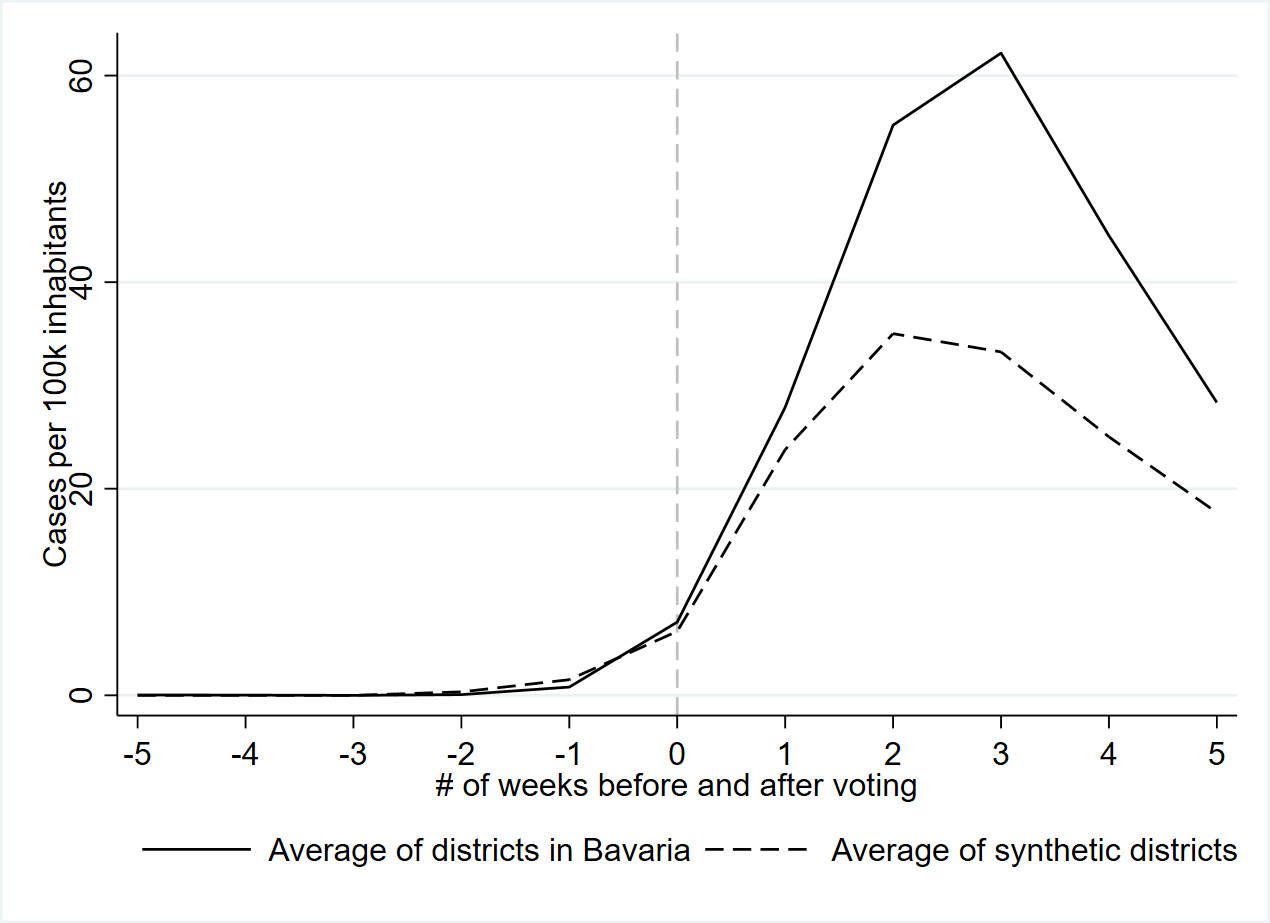 Figure 3: Actual versus synthetic case trajectory in Bavaria — the gap widens roughly two weeks after election day.
- Within Bavaria, a one-percentage-point increase in voter turnout is associated with roughly 12.8 additional confirmed cases and 1.8 additional deaths per 100,000 inhabitants — scaled up to the whole state, this corresponds to about 1,680 additional cases and 236 additional deaths in the period up to April 5, 2020.
- The effect shows up both for in-person voting and mail-in voting. This suggests that it wasn’t only the act of casting a ballot itself that mattered, but also related activities such as campaign events or vote counting.
- For cases, the effect was strongest among 35- to 59-year-olds; for deaths, it was concentrated among those aged 80 and above — consistent with the well-known pattern that older individuals face a substantially higher mortality risk.
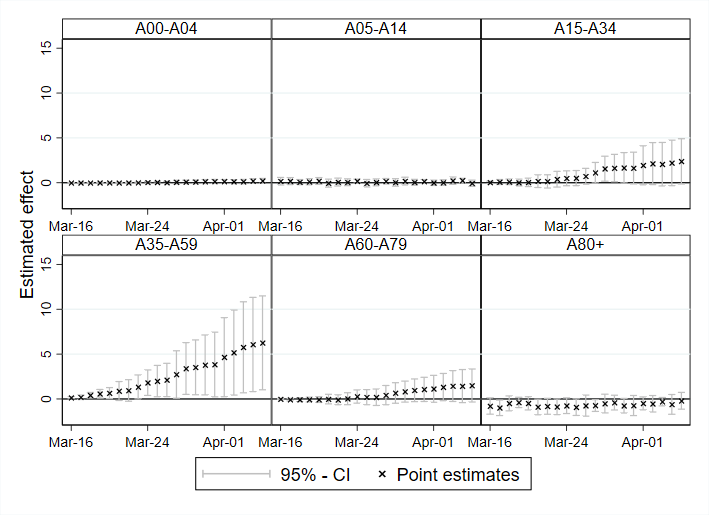 Figure 4: Effect of voter turnout on COVID-19 cases by age group.
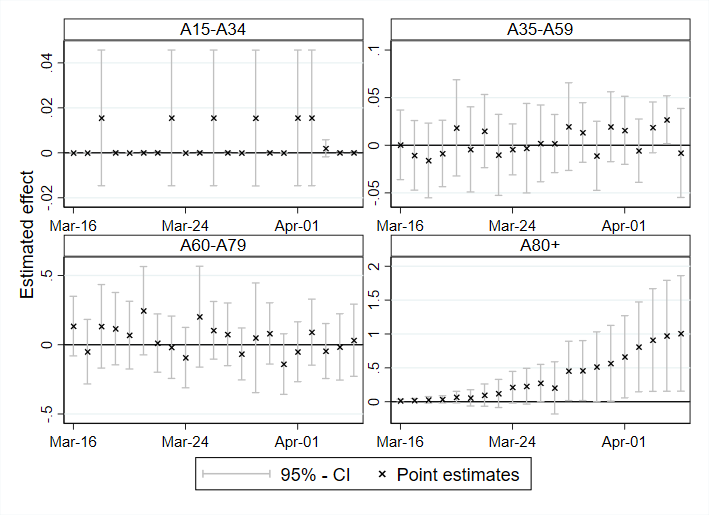 Figure 5: Effect of voter turnout on COVID-19 deaths by age group.
- Our results proved robust across numerous checks — for instance, when using the date of symptom onset instead of the reporting date, or when testing a “placebo election day” in June, for which we find, as expected, no effect.
Why this matters
Our study provides some of the first causally interpretable evidence that the timing of elections during an escalating pandemic can have a measurable impact on the spread of an infectious disease. This doesn’t mean elections should categorically be avoided during crises — after all, they are a cornerstone of democratic systems. But it does underscore how important it is to factor in health risks upfront when deciding on the timing and format of elections — for example, by expanding mail-in voting or enforcing stricter hygiene measures at polling stations, which should also protect poll workers.
Acknowledgments
This paper is the result of a long shared journey, and I want to thank, from the bottom of my heart: my co-authors Jochen Güntner, Felix Krüger, and Amelie Wuppermann for the close and productive collaboration; our student research assistants Armando, Erika, Liselotte, Loredana, and Vera at MLU Halle-Wittenberg for their invaluable help with data preparation; Wolfgang Greiner as the responsible editor at the European Journal of Health Economics for his careful handling of the review process; and two anonymous referees, whose constructive feedback substantially improved the paper.
The paper will soon appear in the renowned European Journal of Health Economics (ABDC: A). A link to the final version will follow once it’s available online.
For example, in our baseline specification, the synthetic twin of the state capital Munich is composed of 57% Stuttgart, 32% Frankfurt am Main, and 11% Leipzig. ↩︎